
Process condensers, steam surface condensers and reboilers, rated zone by zone — with the back-pressure and lost output a dirty condenser costs.
USD 49
| Format | Excel workbook (.xlsx), no macros |
| Version | v1.0 |
| Works in | Excel 2010 or later, Windows and Mac |
| Units | SI, US and British, mixed freely |
| Includes | Guide tab with method and references, calculator, print-ready report |
| Checked against | Steam condenser and toluene reboiler cases within 0.1 % of reference equation-of-state results. |
| Free version | Try the online calculator |
Single-user licence. Team and site licences: see options. Instant download after payment; you also get updates to this major version.
What it does
Three-zone rating
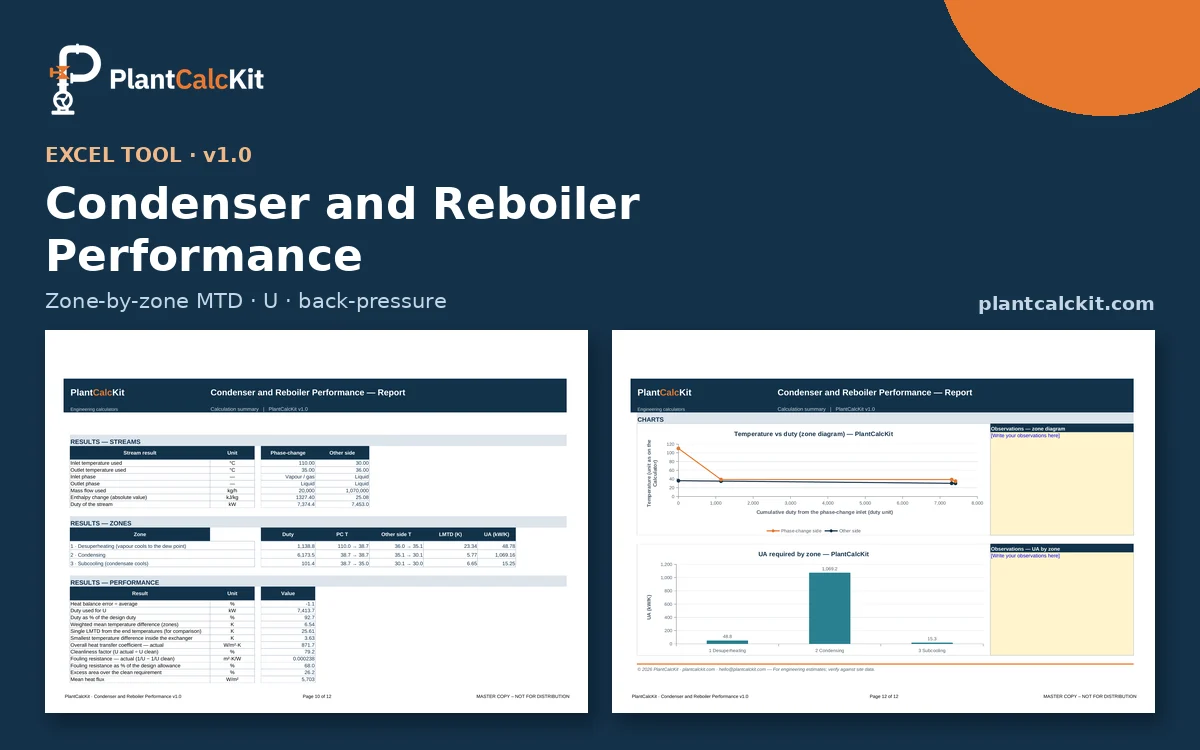
Desuperheat, condense and subcool (or preheat, boil and superheat), with a weighted MTD and the smallest internal temperature difference.
Three services
Process condenser, steam surface condenser, or reboiler / vaporiser.
Pure fluids or mixtures
Pick a fluid from the library, or enter the dew point, bubble point, latent heat and specific heats of a mixture.
Steam condenser results
TTD, ITD, clean back-pressure, excess back-pressure, lost turbine output and its cost; air-blanketing warning.
U, fouling and cleanliness
Actual U, fouling resistance, cleanliness and excess area — and how far a single LMTD would be off.
Charts
Temperature–duty zone diagram and UA by zone, ready to print.
Built for engineers
- Visible formulas — nothing hidden, so you can check every step.
- Fully referenced — methods from the standard references, checked against their published worked examples.
- Safe to share — sheets are protected against accidental edits, with an open password so you can still customise.
- Built-in input checks — clear warnings for impossible inputs and values outside typical ranges.
For engineering estimates; verify against site data. Code-based methods are aligned with the publicly documented procedure; they are not a licensed reproduction or a certification.