
Scaling and corrosion indices, safe cycles, acid feed and the full cost of your treatment programme.
USD 49
| Format | Excel workbook (.xlsx), no macros |
| Version | v1.2 |
| Works in | Excel 2010 or later, Windows and Mac |
| Units | SI, US and British, mixed freely |
| Includes | Guide tab with method and references, calculator, print-ready report |
| Free version | Try the online calculator |
Single-user licence. Team and site licences: see options. Instant download after payment; you also get updates to this major version.
What it does
All the indices
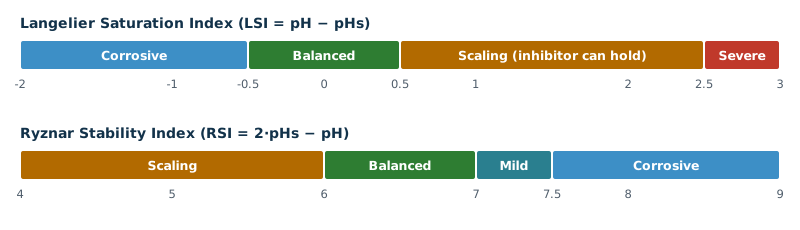
LSI, RSI, PSI and Larson-Skold at bulk and skin temperature, at current and recommended cycles.
Which limit comes first
Calcium carbonate, calcium sulfate, silica, magnesium silicate, chloride and conductivity — the governing limit sets the recommended cycles.
Acid feed
Acid dose to reach a target alkalinity or pH, and the sulfate it adds.
Treatment programme cost
Each product by its general function, dose basis and price; actual versus recommended use.
Recommendations
A ranked list of findings, from low oxidant at high pH to overdosed products.
Generic chemistry only
No supplier names; works for any treatment programme.
Built for engineers
- Visible formulas — nothing hidden, so you can check every step.
- Fully referenced — methods from the standard references, checked against their published worked examples.
- Safe to share — sheets are protected against accidental edits, with an open password so you can still customise.
- Built-in input checks — clear warnings for impossible inputs and values outside typical ranges.
For engineering estimates; verify against site data. Code-based methods are aligned with the publicly documented procedure; they are not a licensed reproduction or a certification.