
Fired heater and furnace efficiency by the stack-loss and input-output methods: LHV and HHV basis, excess air from O2 or CO2, loss breakdown, dew point margin and fuel saving from lower excess air or stack temperature.
USD 39 one-time purchase
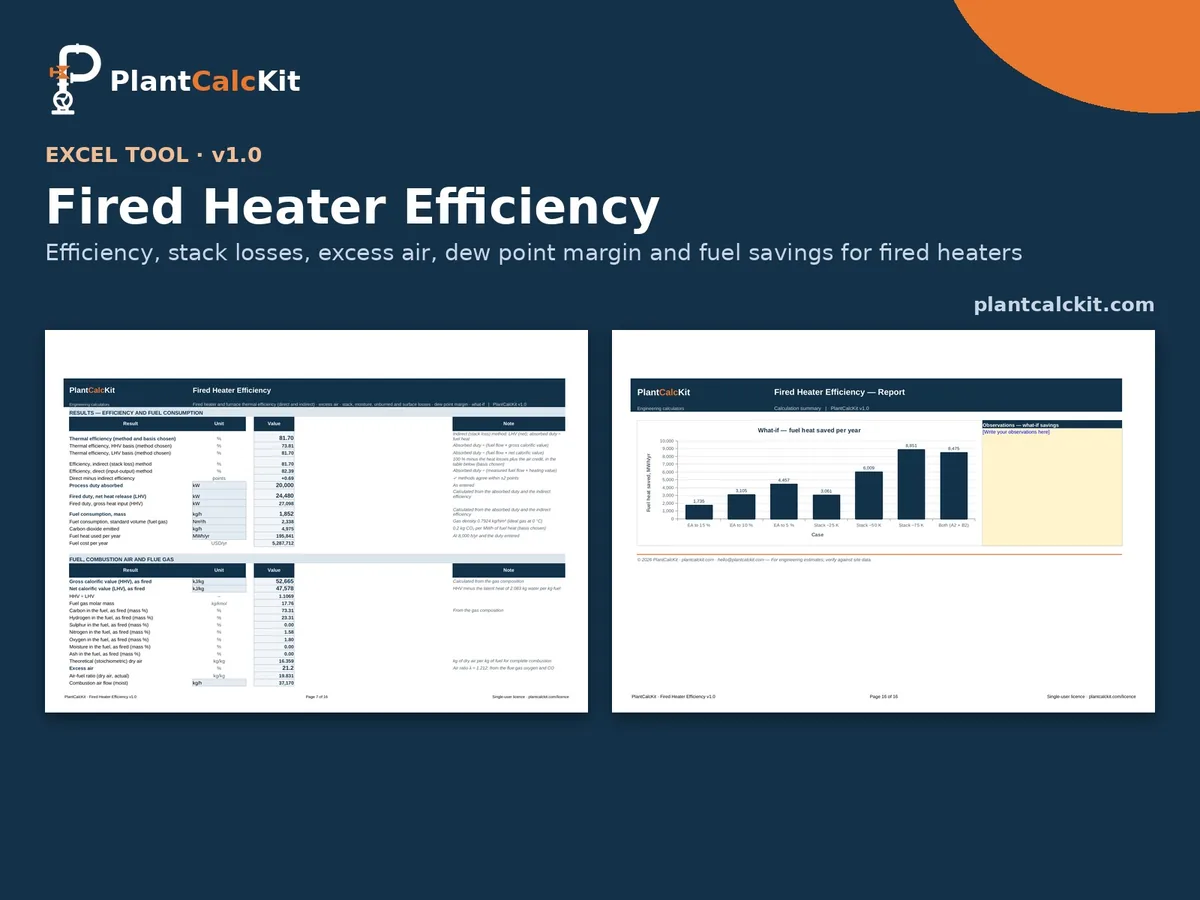
What it does
Fuel gas and fuel oil
Gas composition in mol % or oil ultimate analysis, with generic lean, typical and rich grades you can override.
Excess air from O2 or CO2
Heating values and stoichiometric air from the composition, and excess air from a dry or wet flue gas reading, corrected for CO.
Stack-loss method
Dry flue gas, moisture, CO, unburned combustibles and surface losses, with the credit for preheated combustion air.
Input-output cross-check
Efficiency from the metered fuel flow, with the difference from the stack-loss method shown.
Dew point margin
Water and sulphuric acid dew points against the stack temperature, with a warning when the margin gets thin, plus fuel use and CO2 emitted.
Fuel saving what-if
New efficiency, fuel saved and money per year for lower excess air, a cooler stack, or both.
Built for engineers
- Visible formulas — nothing hidden, so you can check every step.
- Fully referenced — methods from the standard references, checked against their published worked examples.
- Safe to share — sheets are protected against accidental edits, with an open password so you can still customise.
- Built-in input checks — clear warnings for impossible inputs and values outside typical ranges.
For engineering estimates; verify against site data. Code-based methods are aligned with the publicly documented procedure; they are not a licensed reproduction or a certification.
Preview the workbook
An illustration of the sheet layout of this workbook, not a screenshot of calculated results. Select the image to enlarge it. For questions before you buy, email [email protected].
Specification and checks
| Format | Excel workbook (.xlsx), no macros |
| Version | v1.0 |
| Works in | Excel 2010 or later, Windows and Mac |
| Units | SI, US and British, mixed freely |
| Includes | Guide tab with method and references, calculator, print-ready report |
| Checked against | An independent Python model in 214 recalculated runs: all 128 selector combinations, SI, US, British and industry units on fuel gas and fuel oil, result-unit switching and 74 edge and invalid-input cases; about 15,600 values compared, 0 formula errors in LibreOffice. |
| Free version | Try the free excess air calculator |
Compatibility, licence and support
| File | Excel workbook (.xlsx), no macros, version v1.0; works in Excel 2010 or later on Windows and Mac. Sheets are protected against accidental edits, with an open password so you can customise. |
| Licence | Single user. A team licence (up to 5 named users) is 3 × the shop price; site licences on request — licence terms. |
| Updates | Updates to this major version are included; download them again from the link in your receipt. |
| Support | Email [email protected] with your order number — questions on the method, your inputs or your results are welcome. |
| Refunds | If the tool does not work as described, or has an error we cannot fix, email [email protected] with your order number within 14 days of purchase and we will refund you in full. Refunds are not offered for a change of mind once a file has been downloaded. Read the full refund policy. |