
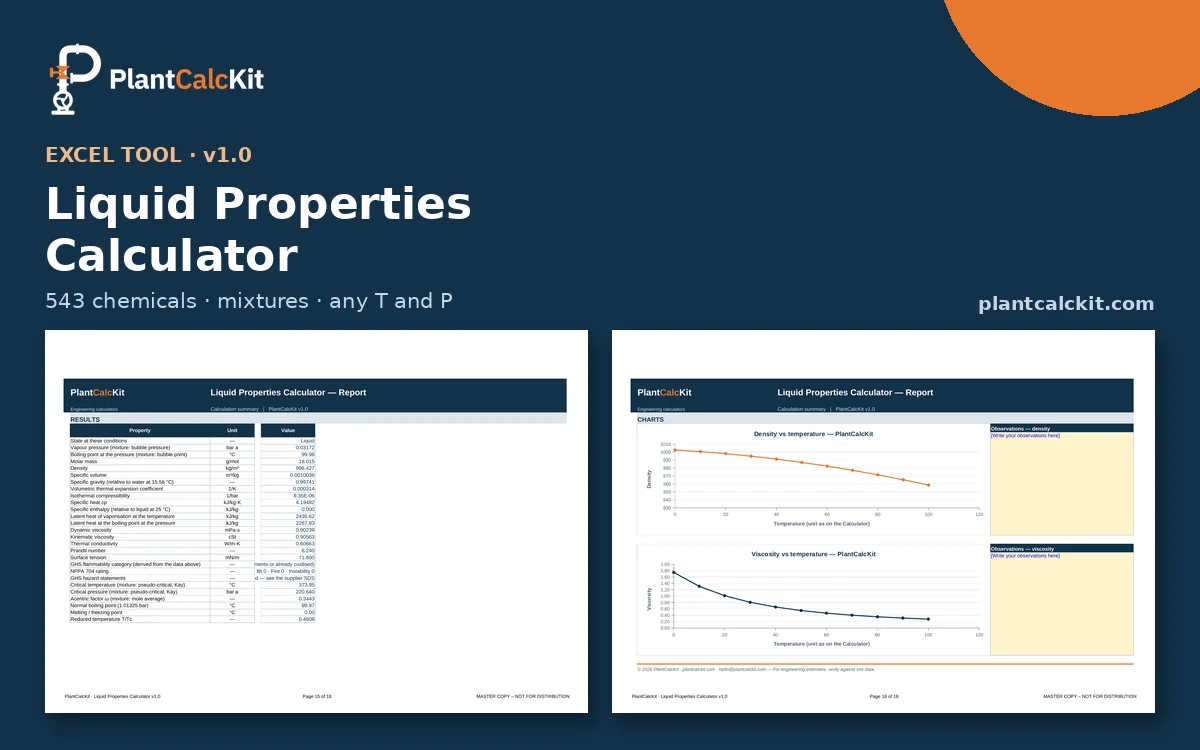
543 chemicals in one alphabetical list, or a liquid mixture: density, cp, viscosity, conductivity, surface tension, vapour pressure, latent heat, heating values and hazard data at any T and P.
USD 49
| Format | Excel workbook (.xlsx), no macros |
| Version | v1.0 |
| Works in | Excel 2010 or later, Windows and Mac |
| Units | SI, US and British, mixed freely |
| Includes | Guide tab with method and references, calculator, print-ready report |
| Checked against | 20 states against reference equations of state: median deviation 0.02 % for density, 0.3 % for cp, 0.6 % for viscosity. |
Single-user licence. Team and site licences: see options. Instant download after payment; you also get updates to this major version.
What it does
543 chemicals, A to Z
The same library as the Gas Properties Calculator, with liquid property curves for each chemical.
Pressure corrections
Compressed-liquid density, and pressure corrections for viscosity and thermal conductivity.
All the liquid properties
Density, cp, viscosity, thermal conductivity, surface tension, vapour pressure, latent heat, expansion and compressibility.
Liquid mixtures
Ideal-solution mixing rules, bubble point and mixture flash point.
Your own data
Enter a measured density or viscosity and the tool corrects the curve through your point.
Heating values and hazards
HHV and LHV of the liquid, NFPA 704 ratings, GHS statements and flash point.
Built for engineers
- Open, citable data — reference equations of state, NIST, IUPAC and other published sources; no values copied from handbooks.
- Data class on every chemical — A (reference) to D (indicative), shown next to the result.
- Published methods — Aalto, Lucas, Missenard, Grunberg–Nissan and others, each cited in the Guide tab.
- Built-in checks — warns when the liquid would boil, near the critical point and outside each chemical's data range.
For engineering estimates; verify against site data. Code-based methods are aligned with the publicly documented procedure; they are not a licensed reproduction or a certification.