
Reactor Heat Removal and Cooling System
Does your reactor cooling system remove the heat of reaction with margin, how much coolant must it circulate, what overall U do the films, wall and fouling give, and what happens to the batch if cooling is lost?
Reactor heat removal capacity, coolant flow, U from films and runaway screening for a jacket, coil or external loop cooler.
USD 49 one-time purchase
What it does
Heat to remove
From conversion and heat of reaction for batch or continuous operation, or a heat release rate, with a peak factor, stirrer power and losses.
Jacket, coil or external loop
Water, thermal oil or brine with generic properties you can overwrite.
Overall U three ways
Entered, built from film coefficients, or from published agitated-vessel and Dittus-Boelter correlations, plus wall and fouling.
Capacity against duty
Effectiveness-NTU capacity at the actual coolant flow, area margin, required UA and the reactor temperature where capacity meets duty.
Coolant flow
Temperature rise, flow for an allowable outlet, minimum coolant flow and turndown.
Runaway screening
Adiabatic temperature rise, MTSR and time to maximum rate under adiabatic conditions from your kinetic data.
Built for engineers
- Visible formulas — nothing hidden, so you can check every step.
- Fully referenced — methods from the standard references, checked against their published worked examples.
- Safe to share — sheets are protected against accidental edits, with an open password so you can still customise.
- Built-in input checks — clear warnings for impossible inputs and values outside typical ranges.
For engineering estimates; verify against site data. Code-based methods are aligned with the publicly documented procedure; they are not a licensed reproduction or a certification.
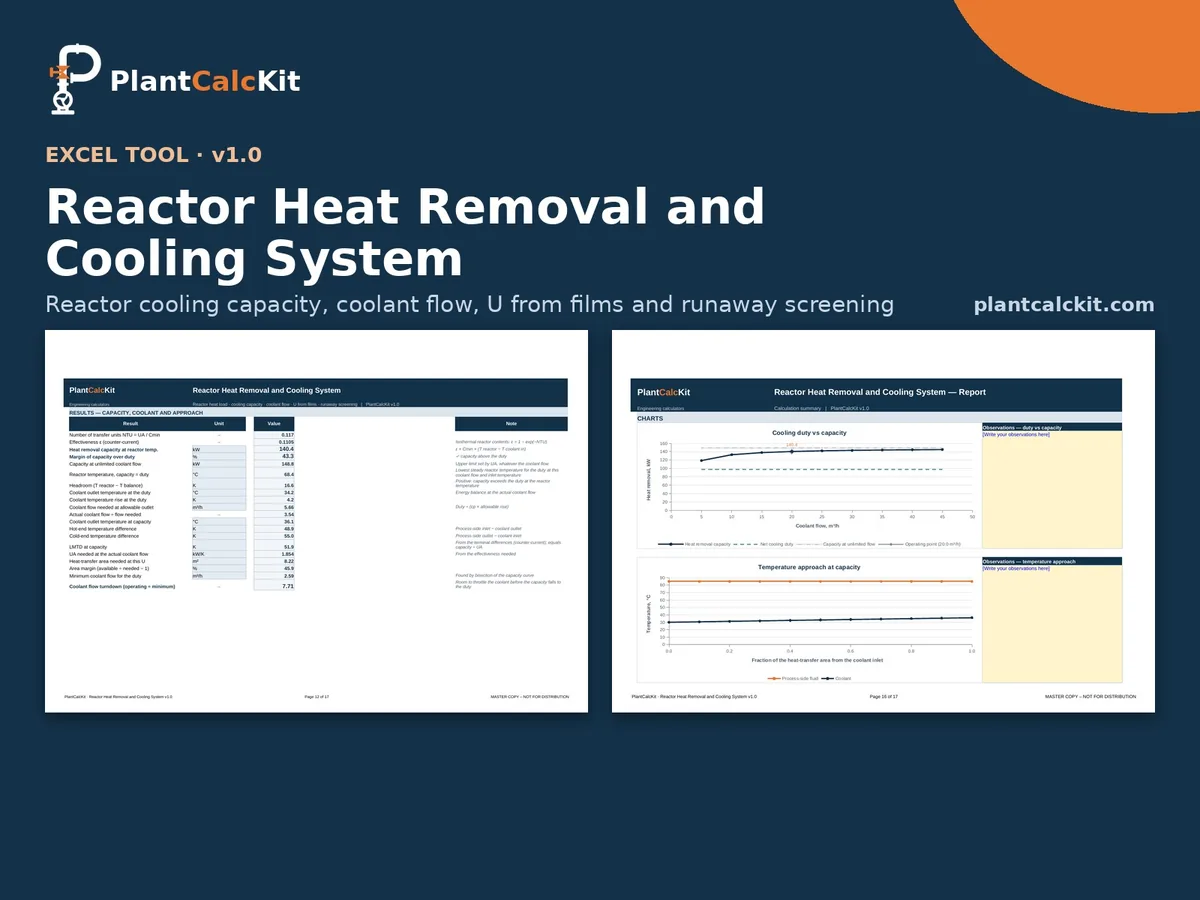
Preview the workbook
An illustration of the sheet layout of this workbook, not a screenshot of calculated results. Select the image to enlarge it. For questions before you buy, email [email protected].
Specification and checks
| Format | Excel workbook (.xlsx), no macros |
| Version | v1.0 |
| Works in | Excel 2010 or later, Windows and Mac |
| Units | SI, US and British, mixed freely |
| Includes | Guide tab with method and references, calculator, print-ready report |
| Checked against | An independent Python model (separate solvers for the capacity, the minimum flow and the runaway temperature) in 498 recalculated runs: the default case, all 162 selector combinations on two data sets, SI, US, British and industry unit sets (identical to 1e-14), the displayed result units, 165 edge and invalid-input cases, about 39,800 values compared; 0 formula errors in LibreOffice. |
| Free version | Try the free tube-side heat transfer coefficient calculator |
Compatibility, licence and support
| File | Excel workbook (.xlsx), no macros, version v1.0; works in Excel 2010 or later on Windows and Mac. Sheets are protected against accidental edits, with an open password so you can customise. |
| Licence | Single user. A team licence (up to 5 named users) is 3 × the shop price; site licences on request — licence terms. |
| Updates | Updates to this major version are included; download them again from the link in your receipt. |
| Support | Email [email protected] with your order number — questions on the method, your inputs or your results are welcome. |
| Refunds | If the tool does not work as described, or has an error we cannot fix, email [email protected] with your order number within 14 days of purchase and we will refund you in full. Refunds are not offered for a change of mind once a file has been downloaded. Read the full refund policy. |
Field guide: Water Treatment, Utilities and Energy Made Simple